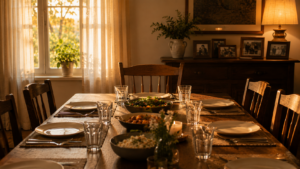
Most families have a chair nobody sits in.
Not officially.
There is no sign.
No reservation.
No written rule.
Yet somehow everyone knows.
At family gatherings, the chair remains empty.
Or if someone sits there, it feels slightly unusual.
Not wrong.
Just different.
The chair once belonged to someone.
A grandparent.
A parent.
An uncle.
A family member whose presence became part of the family’s landscape.
For years they occupied the same place.
Told the same stories.
Asked the same questions.
Made the same jokes.
Often the jokes improved significantly after they were no longer around.
Memory has always been generous with editing.
What remains after someone leaves is rarely just the person.
It is the role they played.
Every family contains invisible roles.
The organizer.
The peacemaker.
The storyteller.
The decision-maker.
The one who remembers birthdays.
The one who remembers everybody’s business.
The one who remembers everybody’s business and shares it freely.
When someone disappears from the family system, the role often disappears with them.
At least for a while.
The interesting thing is that families rarely discuss this directly.
People notice the absence.
They feel the change.
Yet few conversations happen about the empty space left behind.
Instead, the absence quietly teaches something.
It reminds people that relationships are not permanent fixtures.
The routines that feel ordinary today may one day become memories.
The conversations that seem repetitive may eventually become the stories people wish they could hear one more time.
The chair nobody sits in often becomes a symbol.
Not only of loss.
But of contribution.
A reminder that every person influences the people around them in ways they rarely fully understand.
Many people spend their lives wondering whether they matter.
Whether they make a difference.
Whether anyone notices.
The empty chair often answers that question more clearly than words ever could.
People notice.
More than they realize.
The absence of one person can reshape an entire room.
Eventually, someone else may sit in the chair.
The family continues.
New stories emerge.
New traditions form.
That is how families survive.
But even when the seat is occupied again, something remains.
A memory.
A lesson.
A legacy.
A reminder of someone who once helped make the family what it became.
Perhaps that is why certain chairs feel different.
They are not merely furniture.
They are evidence that people leave traces behind.
And sometimes the spaces they leave tell us as much about their lives as their presence ever did.