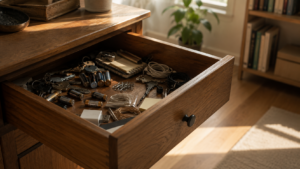
There is a drawer in almost every home.
Nobody plans it.
Nobody officially creates it.
Yet somehow it appears.
A drawer filled with things that might be useful one day.
Old batteries.
Rubber bands.
Instruction manuals for products that no longer exist.
A key that probably belongs to something important.
Or at least it did in 2008.
The contents are usually difficult to explain.
Throwing them away feels risky.
Keeping them feels reasonable.
So they remain.
Year after year.
What is interesting is that people often do the same thing mentally.
Instead of storing old objects, they store old ideas.
Old assumptions.
Old habits.
Old fears.
Old decisions that were never fully examined.
Many of them served a useful purpose at one point.
A belief formed after a difficult experience.
A habit developed during a challenging period.
A rule created to avoid making a mistake.
The problem is not that these things exist.
The problem is that they often stay long after their usefulness has expired.
Just like the drawer.
Most people do not regularly review what they carry.
They simply accumulate.
New experiences arrive.
New responsibilities appear.
New opportunities emerge.
Yet the old beliefs remain stored in the background.
Sometimes these mental leftovers quietly influence important decisions.
A person avoids speaking up because of criticism received years ago.
Someone refuses an opportunity because of a failure that happened decades earlier.
A leader continues using an approach that worked in a different era.
Not because it is still effective.
Because it is still sitting in the drawer.
The funny thing about clutter is that it rarely announces itself.
Nobody wakes up one morning and decides to create a drawer full of random objects.
It accumulates gradually.
One item at a time.
Mental clutter works the same way.
One assumption.
One fear.
One unfinished conversation.
One outdated belief.
Eventually it becomes difficult to tell what is useful and what is simply familiar.
This is why growth often involves subtraction rather than addition.
People spend a great deal of time searching for new ideas.
New strategies.
New answers.
Sometimes the better question is:
What am I still carrying that I no longer need?
Not every belief deserves permanent storage.
Not every habit deserves preservation.
Not every lesson needs to be carried forever.
Occasionally, progress comes from opening the drawer.
Looking inside.
And realizing the mysterious cable has not been useful for fifteen years.
The same may be true of a few other things we continue to keep.